
Recycling and Sustainability for Commercial Waste Removal Haringey
Commercial Waste Removal Haringey takes a practical, measurable approach to creating an eco-friendly waste disposal area and a truly sustainable rubbish area for businesses across the borough. We combine borough-level waste separation practices with business-focused services so that offices, shops and light industrial premises can meet rising environmental expectations. Our approach blends operational change, community partnerships and vehicle technology to reduce landfill, cut emissions and increase reuse.Haringey's commercial waste landscape has evolved to encourage better separation at source and more consistent collections. As part of that evolution our team helps customers implement clear segregation (paper/cardboard, mixed recyclables, glass, food, and residual waste) and supports the borough's strategy for improved resource recovery. By aligning our collections with council guidance we make commercial waste removal in Haringey simpler and more effective for every client.
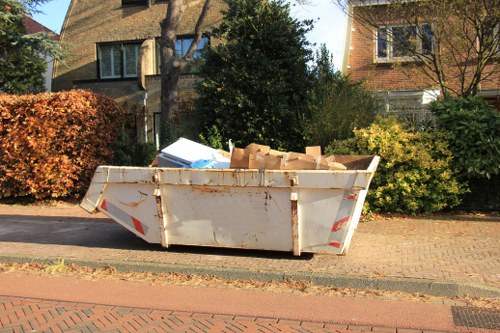 Local transfer stations and processing hubs: we route sorted materials to appropriate local transfer stations and reprocessing facilities serving north London, ensuring that commercial recycling is taken to facilities designed for high-quality recovery. Typical streams handled include:
- Paper and cardboard — baled and sent to paper reprocessors
- Glass — crushed or sorted for reuse
- Plastics — separated by type for mechanical recycling
- Textiles and furniture — diverted to reuse or charity partners
- WEEE and batteries — handled through licensed waste electronics routes
Targets and performance: recycling percentage target
We set an ambitious and transparent recycling percentage target for business clients: a minimum 70% recycling and reuse rate for suitable commercial collections by 2030, with incremental annual targets to drive progress. That target is based on realistic route optimisation, improved segregation, and stronger collaborations with reprocessors. Regular waste audits and reporting help track progress and identify where improvements in the eco-friendly waste disposal area can be made.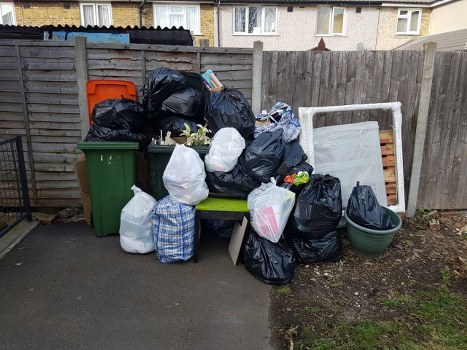
Low-carbon fleet and operational measures
To support a low-carbon approach to Haringey commercial waste, our fleet increasingly uses electric and hybrid vans alongside efficient route planning software. These low-carbon vans reduce urban emissions and noise, and their deployment is coordinated so that dense commercial streets have frequent, consolidated collections rather than many small, inefficient pickups. We also measure and publish fleet emissions as part of our sustainability reporting.Partnerships with charities and reuse networks are central to moving from disposal to reuse. We maintain active links with local charities and community groups to redirect reusable office furniture, working electronics, and surplus stock. By creating agreed pickup windows and simple donor flows, items that would otherwise be counted as waste enter the circular economy and support local causes — a practical win for the sustainable rubbish area vision.
Practical service design for businesses includes segregated containers for mixed recycling, food waste, and residual waste. We support Haringey commercial waste clients with bespoke signage, staff briefings and collection cadences that reflect the borough’s approach to waste separation. For construction and demolition waste from small works, we co-ordinate skips and segregated loads so that inert materials, metals and wood are recovered where possible rather than landfilled.
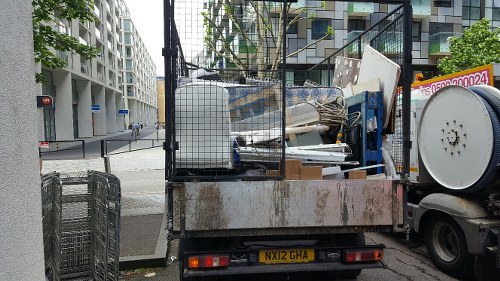 How we make it work on the ground: audits identify the highest-volume streams and the simplest behavioural changes to improve capture rates. Implemented changes are reinforced by operational tools — clear labelling, colour-coded bins and scheduled charity pickups for reusable items. We also provide documented waste transfer notes and tonnage reports to support your internal environmental targets without adding administration burden.
 Measuring success means looking beyond single-collection metrics. We track diversion from landfill, the proportion of material sent to certified reprocessors, and the number of items reused via charitable partners. Our work contributes to a broader eco-friendly waste disposal area across Haringey by strengthening local secondary markets for recycled materials and by reducing the carbon footprint of commercial waste streams through better separation and transport efficiency.
Examples of commercial recycling activity relevant to the borough include targeted food waste capture from cafés and canteens, dedicated e-waste days for offices, and textile collections for retail outlets. These lighter-touch interventions often yield significant gains when repeated consistently. We also collaborate with other north London hauliers and municipal hubs to route specific streams to specialist processors, helping maintain high-quality recycling standards across the region.
To ensure ongoing improvement we set short-term milestones that cascade up to the 2030 goal: quarterly review of diversion rates, annual fleet electrification targets, and expanding our charity partner network. These actions support a resilient, localised system that turns the concept of a sustainable rubbish area into operational reality for businesses of all sizes in Haringey.
In summary, our model for Commercial Waste Removal Haringey combines clear recycling percentage targets, partnerships with charities, links to local transfer stations, and a low-carbon fleet to create a scalable, measurable route to sustainability. By aligning business collections with the borough's waste separation approach and investing in reuse pathways, we reduce environmental impact while helping organisations meet their sustainability commitments.
